Description
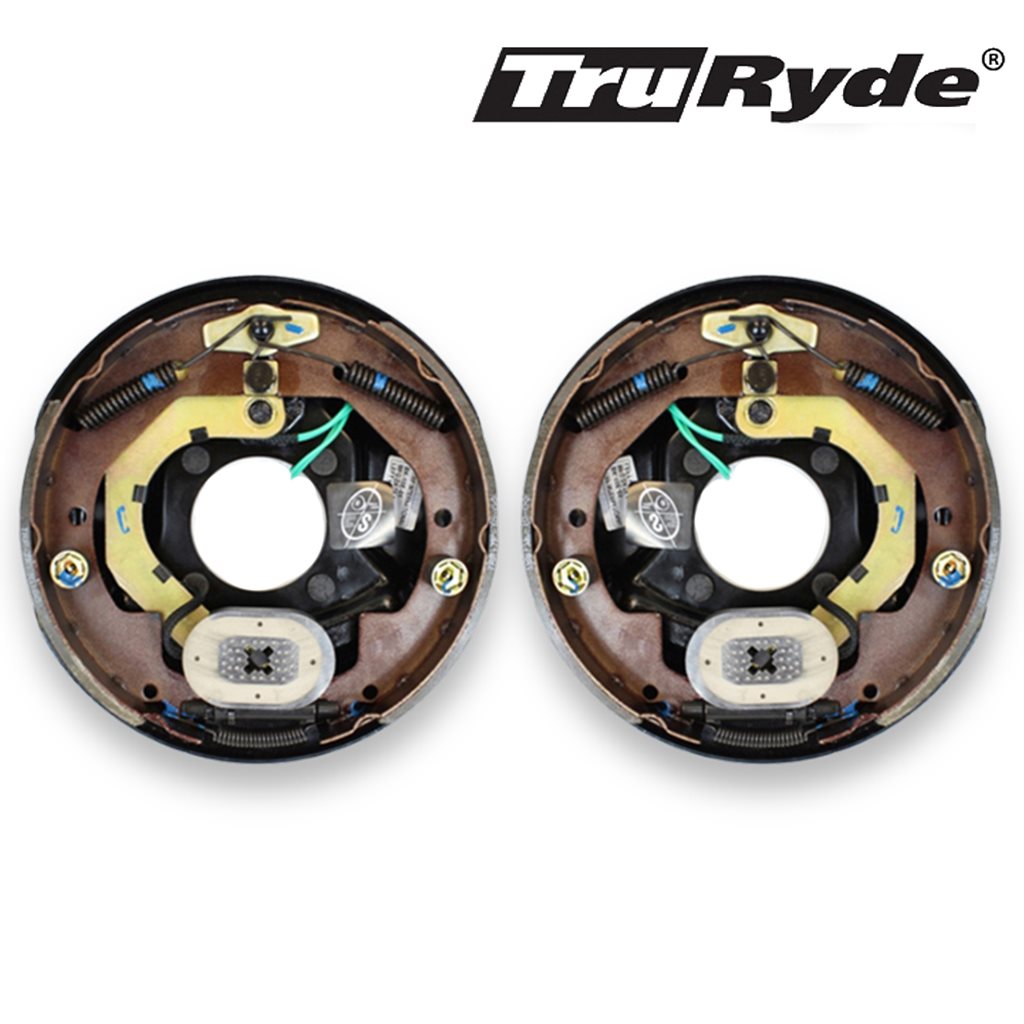
Pair of 10″ x 2.25″ electric trailer brake assemblies no parts. 4 Hole Mounting. For Alko, Dexter, Quality, Lippert, Rockwell or other popular trailer axle manufacturers. Only works on 3,500 lbs. trailer axles with four-hole brake flange. No mounting hardware is included. These are fully assembled backing plates with shoes, springs, and magnets attached and ready to be mounted. The pair includes one left hand and one right hand brake assembly. Quality standards test the same as domestic backing plates.
TruRyde® Part Number BK-10E-01 is compatible with Dexter® Part Number 023-026-00
TruRyde® Part Number BK-10E-02 is compatible with Dexter® Part Number 023-027-00
| Part No | Quantity | Description |
| BK-10E-01 | 1 | 10″ x 2 1/4″ 3.5K Electric LH |
| BK-10E-02 | 1 | 10″ x 2 1/4″ 3.5K Electric RH |
STANDARD BURNISHING PROCEDURE
1. Turn the gain on the trailer brake control to the maximum level.
2. Proceed at driving speeds up to 40 mph.
3. Move the slide mechanism on the brake controller to apply 8 to 10 volts to the trailer brakes allowing the tow vehicle to slow down to 20 or 25 mph.Please note – do not use tow vehicle brakes or exhaust brakes during this period – the trailer brakes will seat in faster by only using the trailer brake.
4. Release the slide mechanism on the brake controller.
5. Continue down the road applying the brake controller at one-mile intervals.Please note – you should feel a noticeable difference in the brake performance during this period, sometimes in as few as ten applications.
6. After 20 to 50 applications, use your best judgment on brake performance.
7. Pull over to a safe location to check the procedure status.
If you notice smoke stemming from the brake or axle area, this is normal due to the burnishing procedure. To ensure that temperatures are within the normal range, you can use a temperature gun to check that temperatures are between 350 and 400 degrees, or you can do a hand check by hovering your hand around the brake area without touching the brake drum.If there is no smoke, the heat has not achieved the proper temperature, or the area can be touched with a hand, perform the procedure again. If the brake drum is cold to the touch, the brakes may not be adjusted appropriately, or there may be a wiring concern.